What Is the Kataragama Festival and Why Does It Matter?
If you are searching for the Kataragama Festival 2026 dates, you are already on the path to one of the most extraordinary spiritual experiences in all of Asia. Held annually at the Ruhunu Kataragama Mahadevala in the deep south of Sri Lanka, this festival is not a performance staged for tourists — it is raw, living faith at its most powerful and most personal. Devotees walk barefoot for days across jungle terrain, smash coconuts in surrender to the divine, pierce their bodies with metal skewers, and dance with kavadi frames weighing dozens of kilograms, all to honour Lord Kataragama — also known as Skanda Murugan, the god of war, victory, and transformation.
In This Guide
- What Is the Kataragama Festival and Why Does It Matter?
- Kataragama Festival 2026 Dates and Schedule
- The Sacred Site: Kataragama Mahadevala
- How to Get to Kataragama
- Entry Fees, Opening Hours, and Practical Information
- What to Bring and How to Behave
- Beyond the Festival: Combining Kataragama With Nearby Attractions
The festival draws pilgrims from every faith that calls Sri Lanka home: Hindu, Buddhist, Muslim, and indigenous Vedda communities all converge here, making Kataragama one of the rare sacred sites on earth where multiple religions share the same holy ground without conflict. The ancient Kiri Vehera stupa, believed to be over 2,000 years old and standing just metres from the main devala, is a constant reminder that this place holds Buddhist significance just as deep as its Hindu roots.
Whether you are a devoted pilgrim, a curious traveller, or someone simply open to an experience that will stay with you long after you leave Sri Lanka, the Kataragama Festival belongs on your itinerary.
Kataragama Festival 2026 Dates and Schedule
The Kataragama Festival follows the Esala lunar calendar, which means the exact dates shift slightly each year. For 2026, the festival is expected to fall across a two-week period in July and August 2026, with the grand Water Cutting ceremony (Diya Kapana) marking the climactic finale. Historically the festival runs for approximately 14 to 15 days, beginning on the full moon of the Esala month.
Based on the lunar calendar, the Kataragama Festival 2026 is anticipated to begin around late July 2026, with the closing Water Cutting ceremony expected in mid-August 2026. Always verify the precise dates closer to the time through the Kataragama Devale Trust or official Sri Lanka Tourism announcements, as lunar calendar conversions can shift by a day or two.
Key Festival Events and Their Timings
- Opening Ceremony (Flag Hoisting / Kap Situveema): Marks the official start of the festival. Takes place at the Mahadevala in the evening.
- Nightly Perahera Processions: Costumed elephants, drummers, torch bearers, and kavadi dancers parade through the sacred precinct every evening after sundown throughout the festival period.
- Kavadi Dances: Devotees carrying ornate, often heavy kavadi frames — sometimes with body piercings — dance in a trance-like state as an act of devotion to Lord Murugan.
- Fire Walking (Thimithi): One of the most dramatic rituals of the festival. Devotees walk across a bed of burning coals, demonstrating absolute faith in the deity's protection.
- Coconut Smashing (Pol Kapima): A continuous daily ritual at the temple grounds where devotees smash coconuts against a stone as a symbolic offering and surrender of ego.
- Puja Offerings: Elaborate fruit offerings — beautifully arranged and presented to the deity — take place multiple times daily. After the puja, blessed fruits are distributed to devotees.
- Water Cutting Ceremony (Diya Kapana): The grand finale held at the Manik Ganga river beside the temple. A priest symbolically cuts the water with a sword at midnight, marking the end of the festival.
Festival Timing: The Kataragama Festival 2026 is expected to run for approximately 14 nights in late July to mid-August 2026. The most spectacular nightly perahera processions begin after 8:00 PM and the fire walking typically takes place in the final days of the festival. Plan to arrive at least one full day before you want to witness major rituals.
The Sacred Site: Kataragama Mahadevala
The golden gate of Ruhunu Kataragama Devala is the iconic first image that greets every visitor entering the sacred precinct — and it sets the tone immediately. Beyond it lies a complex that is simultaneously a functioning temple, a living pilgrimage site, and one of the most spiritually charged places in Sri Lanka.
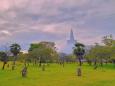
The main shrine is dedicated to Lord Kataragama (Skanda Murugan), but the complex encompasses several places of worship. The Kiri Vehera Buddhist dagoba stands just beside the Hindu devala, its white dome soaring above the tree line. Nearby, the Menik Ganga — a sacred river — flows gently past the precinct, and devotees ritually bathe here before entering the temple. The scent of incense is constant. Drums sound at puja times. The atmosphere is unlike anywhere else.
Outside the main gate, the surrounding streets fill with colourful stalls selling everything from sacred offerings — flowers, camphor, coconuts — to souvenirs, street food, and devotional items. Even on ordinary days outside festival season, Kataragama thrums with a spiritual energy that is difficult to describe and easy to feel.
Visitor Tip: Dress modestly before entering the temple precinct — shoulders and knees must be covered for both men and women. You will be asked to remove footwear before entering the inner shrine area. Bring a small cloth bag to carry your shoes. Early morning puja (around 6:00–6:30 AM) and evening puja (around 6:30–7:00 PM) are the most atmospheric times to visit outside of festival processions.
How to Get to Kataragama
Kataragama is located in the deep south of Sri Lanka, roughly 300 kilometres from Colombo and about 100 kilometres east of the popular coastal town of Weligama. The town sits within the dry zone close to Yala National Park, which makes it an excellent addition to a south coast itinerary.
From Colombo
- By Bus: Direct buses run from Colombo Central Bus Stand to Kataragama. Journey time is approximately 6 to 7 hours. Intercity express buses are more comfortable and cost around LKR 600–900 (USD 2–3).
- By Private Car or Taxi: The most comfortable option for independent travellers. Expect to pay USD 60–90 for a one-way private transfer from Colombo. Journey time is 4.5 to 5.5 hours depending on traffic.
- By Train + Tuk-Tuk: Take the train from Colombo to Matara (approximately 3 hours, LKR 200–600 depending on class), then arrange a tuk-tuk or bus connection onwards to Kataragama (roughly 2 more hours).
From Ella or the Hill Country
Kataragama is approximately 120 kilometres from Ella, making it a natural pairing on a hill country to south coast route. Private taxis from Ella cost approximately USD 35–55 and the journey takes around 2.5 to 3 hours through stunning scenery past Wellawaya.
From Mirissa, Weligama, or Galle
From the popular surf coast, Kataragama is around 2 to 3 hours by private car (USD 30–50). During festival season, shared buses become crowded so booking a private vehicle is strongly recommended.
Festival Season Warning: During the Kataragama Festival 2026, roads into the town will be extremely congested, particularly in the final three to four days. Hundreds of thousands of pilgrims — many walking on foot along the main roads — converge on the town. Book accommodation well in advance (3 to 6 months ahead), arrange private transport rather than relying on buses, and budget extra time for road delays. Arriving the evening before a major ritual is strongly advised.
Entry Fees, Opening Hours, and Practical Information
Entry Fees
There is no entrance fee to enter the Kataragama sacred precinct or the main Mahadevala temple. The site is open to visitors of all faiths and nationalities. Donations are welcomed and customary when participating in or observing rituals. If you hire a local guide to explain the significance of rituals, expect to pay USD 10–20 for a 2-hour tour.
Opening Hours
- Temple Precinct: Open daily, approximately 5:00 AM to 9:00 PM (outer areas remain accessible later during festival)
- Morning Puja: Approximately 6:00–6:30 AM
- Midday Puja: Approximately 10:30–11:00 AM
- Evening Puja: Approximately 6:30–7:00 PM
- Festival Perahera Processions: Begin after 8:00 PM nightly during the festival
Budget Guide (Per Person)
- Budget traveller: USD 25–40 per day (guesthouse, local meals, bus transport)
- Mid-range traveller: USD 60–100 per day (comfortable hotel, private transport, guided experience)
- Puja offering materials: USD 2–8 (flowers, coconut, camphor from street stalls)
- Street food meal near the temple: USD 1–3
- Sit-down restaurant meal: USD 5–12
What to Bring and How to Behave
Kataragama demands respect — and rewards it. Travellers who approach with genuine curiosity and cultural sensitivity consistently describe it as one of the most moving experiences of their time in Sri Lanka.
What to Bring
- Modest clothing: lightweight long trousers or a sarong for men, long skirt or trousers and a top covering the shoulders for women
- A sarong (available cheaply from stalls outside the temple) as a backup cover-up
- A small bag for your shoes when entering the inner shrine
- Cash in LKR — most stalls and guesthouses do not accept cards
- Water bottle — the dry zone heat is intense, especially during July and August
- Sunscreen and a hat for time spent outside the shaded precinct
- A camera or phone, but be respectful when photographing devotees during rituals — always ask permission and never photograph fire walkers or kavadi dancers intrusively
How to Behave
- Remove shoes before entering the inner shrine area
- Do not point your feet toward the shrine or sacred images
- Observe quietly during puja ceremonies — this is not a performance
- If you wish to make an offering, purchase materials from the stalls outside and follow the lead of other devotees
- Do not touch devotees who are in a trance state during kavadi rituals
Beyond the Festival: Combining Kataragama With Nearby Attractions
Kataragama's location in the deep south makes it a natural gateway to some of Sri Lanka's most spectacular natural and cultural sites. Even if your primary purpose is the 2026 festival, consider extending your trip to include the following.
Yala National Park
Sri Lanka's most famous wildlife reserve sits just 20 kilometres west of Kataragama. Yala is home to the world's highest density of wild leopards as well as elephants, sloth bears, crocodiles, and hundreds of bird species. Morning and evening safari drives can be arranged from Kataragama, typically costing USD 40–70 per person including jeep and park fees.
Udawalawe National Park
About 90 kilometres northwest of Kataragama, Udawalawe is the best place in Sri Lanka to see large herds of wild elephants. A half-day safari typically costs USD 35–55 per person.
Bundala National Park and Lagoons
A UNESCO Biosphere Reserve between Kataragama and Hambantota, Bundala is outstanding for birdwatching — flamingos, painted storks, and thousands of migratory species visit the lagoons between November and March, but the park is worth visiting year-round.
Combining a Kataragama Festival visit with a Yala safari and a few days on the south coast creates one of the most complete Sri Lanka itineraries possible — culture, wildlife, spirituality, and beach all within a compact geographical area.
Frequently Asked Questions
What are the Kataragama Festival 2026 dates?
The Kataragama Festival 2026 is expected to run for approximately 14 to 15 nights in late July to mid-August 2026, following the Esala lunar calendar. The festival concludes with the Water Cutting ceremony on the full moon night. Confirm exact dates closer to the time via Sri Lanka Tourism official channels, as lunar calendar dates can shift by one or two days year to year.
Is the Kataragama Festival open to non-Hindu visitors and tourists?
Yes, the Kataragama Festival and the temple precinct are open to visitors of all faiths and nationalities. Kataragama is uniquely multi-religious, drawing Hindu, Buddhist, Muslim, and Vedda pilgrims together. Tourists are welcome to observe rituals respectfully, make offerings, and participate in the atmosphere, provided they dress modestly, remove shoes in the inner shrine, and behave with sensitivity.
How far in advance should I book accommodation for the Kataragama Festival 2026?
Book at least 3 to 6 months in advance if you plan to stay in Kataragama town during the festival. Accommodation within the town is limited and fills extremely quickly for the festival period, particularly the final three to five nights. Nearby towns such as Tissamaharama (about 25 km away) offer more options and are a viable base if Kataragama itself is fully booked.
What is the fire walking ritual at Kataragama and is it safe to watch?
Fire walking (Thimithi) at Kataragama involves devotees crossing a long bed of burning coals barefoot as an act of extreme devotion to Lord Murugan. It typically takes place in the final days of the festival at night. It is completely safe for spectators to watch from a respectful distance. Do not attempt to cross yourself, do not touch participants, and follow crowd management instructions from temple officials.
What should I wear and bring to the Kataragama Festival?
Wear modest, lightweight clothing that covers your shoulders and knees — the dry zone heat in July and August is intense, so breathable cotton or linen fabrics are ideal. Bring a sarong as a backup (available cheaply outside the temple), a small bag for your shoes, cash in Sri Lankan Rupees, a water bottle, and sunscreen. A camera is fine but photograph devotees only with respectful discretion.
Comments
لا توجد تعليقات حتى الآن. Be the first!